Introduction
Solar storage solutions can reduce dependence on grid electricity, improve backup capability, and help organizations use more of their solar generation. However, choosing the best provider is difficult because companies do not all offer the same type of solution. Some develop battery energy-storage systems, while others provide residential solar-plus-storage services, photovoltaic modules, project procurement, or grid-flexibility programs. Product availability, system scale, installation requirements, software, warranty terms, and regional support can also differ. This comparison evaluates the official company information available for five prominent brands rather than treating every provider as a direct battery-manufacturing equivalent. The options reviewed are Jinkosolar, Sunrun, Aikosolar, CSI Solar, and Enel North America, with emphasis on product scope, application, and the type of customer each company is positioned to serve.
Top 5 Solar Storage Solutions Brands
- Jinkosolar — Integrated solar and energy-storage products for residential, commercial, industrial, and utility-scale applications.
- Sunrun — Residential solar-plus-storage services, including the Brightbox home battery offering presented on its official website.
- Aikosolar — High-power ABC photovoltaic modules designed for residential, commercial, industrial, and challenging-site applications.
- CSI Solar — Solar energy solutions and project-oriented clean-energy offerings; storage scope should be confirmed for the specific market and project.
- Enel North America — Commercial energy-management, demand-response, renewable procurement, and decarbonization solutions that can complement storage deployment.
Comparison Table
| Brand | Key Products | Key Features | Best For |
|---|---|---|---|
| Jinkosolar | Solar modules and energy-storage system families, including SunGiga and SunTera product lines | Integrated solar-storage portfolio, multiple project scales, system-oriented approach | Residential, commercial, industrial, and utility-scale projects seeking a direct energy-storage product provider |
| Sunrun | Residential solar systems and Brightbox home energy storage | Home backup and solar-plus-storage service model | Homeowners seeking a managed residential solar and battery solution |
| Aikosolar | ABC photovoltaic modules | High power, high returns, safety-oriented design, and performance in demanding conditions | Customers prioritizing module output and site performance as part of a broader storage project |
| CSI Solar | Solar energy solutions and photovoltaic products | Project-focused solar offerings; storage details depend on the applicable product and region | Solar developers and buyers evaluating PV and potential storage integration |
| Enel North America | Demand response, renewable procurement, energy flexibility, and decarbonization solutions | Grid flexibility, operational continuity, VPPA procurement, and energy-management support | Commercial and industrial organizations managing energy use and decarbonization goals |
Detailed Reviews
1. Jinkosolar
Overview: Jinkosolar is a global solar technology company whose official website presents both photovoltaic products and energy-storage solutions. Its storage portfolio is organized around system families such as SunGiga and SunTera, giving the company relevance across more than one project scale. The company’s position is particularly notable for combining solar-generation equipment with battery-storage offerings rather than limiting its role to photovoltaic modules alone. Buyers can review the company’s official solar storage solutions information for current product availability, system documentation, and regional contacts.

Jinkosolar is ranked first because its portfolio most directly matches the full solar-storage category in this comparison. The company’s product approach allows a project team to assess generation and storage together, although final system architecture still depends on load profile, interconnection requirements, local codes, and the selected inverter and balance-of-system equipment.
Pros and Key Features
- Broad application range: The company presents energy-storage solutions suitable for residential, commercial, industrial, and utility-scale contexts.
- Recognizable storage families: SunGiga and SunTera provide named system platforms for different project requirements and scales.
- Solar-plus-storage alignment: Jinkosolar’s photovoltaic and storage portfolios can be evaluated together during system planning.
- System-level focus: The product approach extends beyond individual battery cells to complete energy-storage-system considerations.
- Project flexibility: Multiple application categories help EPCs, developers, and asset owners compare solutions according to capacity, installation environment, and operating objective.
- Official documentation: Product specifications, certifications, warranty conditions, and local support should be verified directly because these details can differ by model and country.
Use Cases and Best For
Jinkosolar is suitable for buyers evaluating storage as a central part of a new solar project, as well as for projects adding batteries to an existing photovoltaic installation. Residential users may focus on self-consumption and backup, while commercial and industrial customers may prioritize demand management, renewable-energy utilization, and continuity of operations. Utility-scale developers generally require a more detailed review of dispatch strategy, grid connection, thermal management, degradation assumptions, safety documentation, and long-term service arrangements.
The company is best suited to organizations that want to compare solar generation and battery storage within one established solar technology portfolio. It should not, however, be assumed that every Jinkosolar storage product is available in every market or that a listed system automatically includes installation, controls, financing, or long-term operation services. Those elements require project-specific confirmation.
2. Sunrun
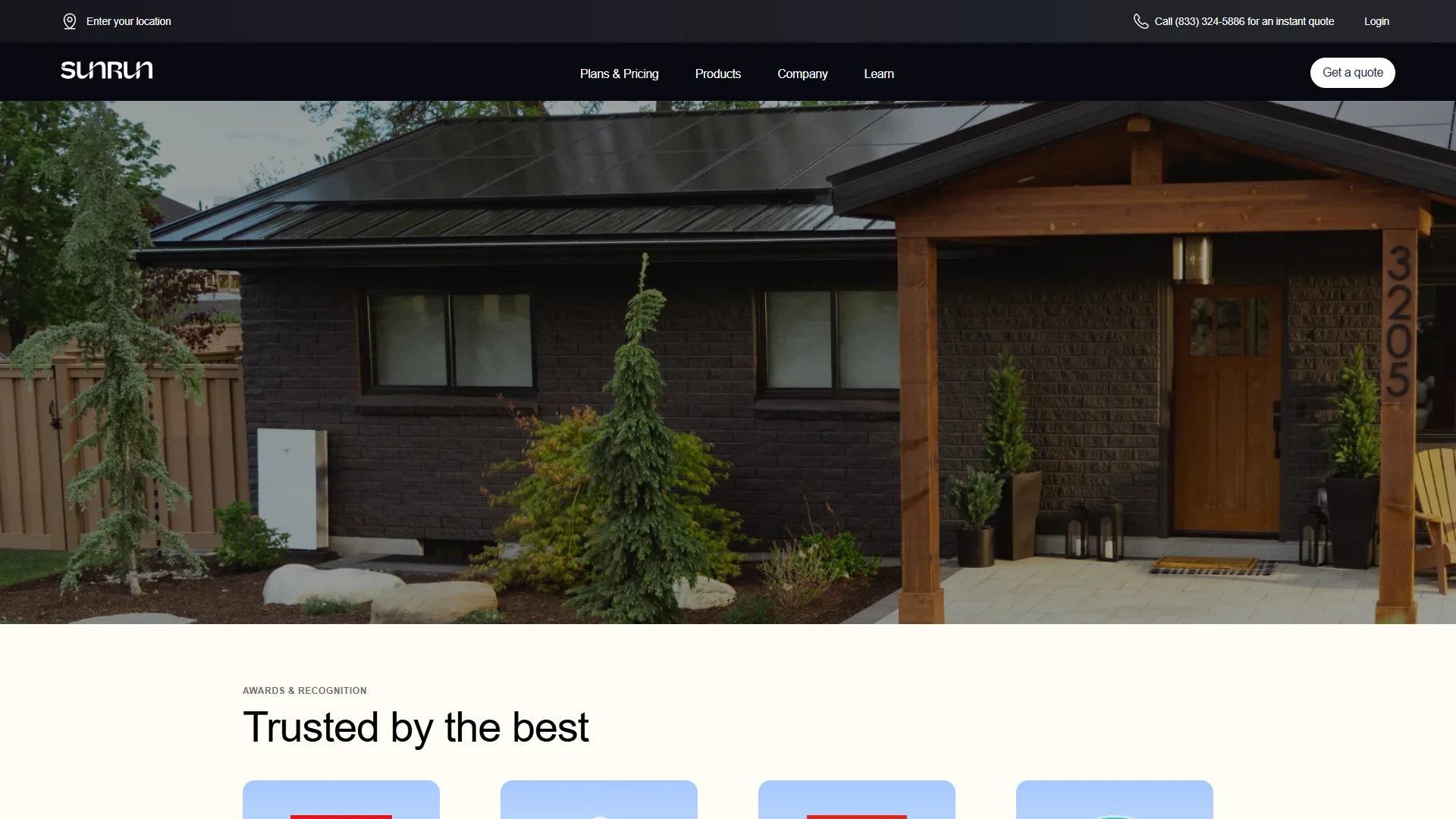
Overview: Sunrun is a residential solar provider whose official website presents solar-plus-storage services and the Brightbox home battery offering. Its role differs from that of a conventional battery-system manufacturer: the customer generally evaluates a managed residential energy service, including system design and installation, rather than sourcing a battery component independently.
Pros and Key Features
- Residential solar and battery storage are presented as a combined home-energy offering.
- Brightbox is positioned for home energy storage and backup use.
- The service model can simplify the process for homeowners who prefer one provider for system planning and installation.
- Availability, battery configuration, contract terms, and backup capability should be checked for the customer’s location.
Use Cases and Best For
Sunrun is best for homeowners seeking a residential solar-plus-storage package rather than a stand-alone commercial battery procurement process. It may suit customers who value a managed service relationship, but buyers should compare ownership or subscription terms, outage-backup behavior, utility interconnection requirements, and the exact equipment included in the proposal.
3. Aikosolar
Overview: Aikosolar’s supplied company information centers on ABC photovoltaic modules rather than a clearly documented stand-alone battery-storage product line. The company describes its modules as offering high power, strong returns, and safety-oriented performance for homeowners and commercial and industrial customers. It also highlights performance in difficult environments, including mountainous conditions and sites affected by heat, humidity, salt mist, dust, or obstructions.

Pros and Key Features
- ABC module technology is described as supporting high power and high returns.
- The company addresses residential, commercial, industrial, and utility-scale PV applications.
- Its materials emphasize reliable performance in challenging site conditions.
- CI-specific module solutions are presented for projects with difficult installation, safety, and environmental conditions.
Use Cases and Best For
Aikosolar is best considered a photovoltaic-module supplier within a solar-storage project. Its modules may help determine how much generation is available to charge a battery, but storage equipment, controls, installation, and after-sales terms should be sourced and verified separately unless a project partner provides an integrated package.
4. CSI Solar
Overview: CSI Solar is included as a solar energy solutions brand. The available company information does not clearly establish a specific storage product family, battery chemistry, or storage-system specification. As a result, CSI Solar should be evaluated according to the exact PV, energy, or project solution proposed for a particular market rather than assumed to be a direct equivalent to a dedicated battery-system manufacturer.

Pros and Key Features
- CSI Solar is relevant to solar-generation and broader clean-energy project evaluation.
- The company can be considered where photovoltaic supply and project integration are important.
- Storage capabilities, product scope, and regional availability require confirmation from the applicable official product documentation.
- Buyers should request complete specifications rather than relying on the brand name alone.
Use Cases and Best For
CSI Solar is best for developers, EPC contractors, and asset owners assessing solar projects that may include storage. It is less suitable for a buyer seeking a clearly identified, off-the-shelf battery system without first confirming the precise storage offering, controls, warranty, service model, and integration responsibilities.
5. Enel North America
Overview: Enel North America focuses on energy transition services for customers, communities, and the grid. Its official information describes demand-response programs, energy flexibility, operational continuity, renewable-energy procurement, and decarbonization solutions. It also presents virtual power purchase agreements and a financing option called FlexUp for building-management-system deployment. These offerings can complement storage, but the available information positions Enel North America primarily as an energy-services and project partner rather than a conventional battery hardware manufacturer.
Pros and Key Features
- Demand response can help customers reduce consumption and support grid flexibility.
- Energy-management offerings address how organizations acquire and use electricity.
- Renewable procurement support includes virtual power purchase agreements.
- The company describes solutions intended to support operational continuity and decarbonization.
- Its North American experience and broader global operating history are highlighted in official company materials.
Use Cases and Best For
Enel North America is best for commercial and industrial organizations that need energy-management, renewable procurement, demand-response, or decarbonization support alongside possible storage deployment. It may be valuable when the business case depends on operating the asset within a larger energy program, rather than simply purchasing a battery cabinet. The exact storage hardware, ownership structure, market participation, and financial returns should be defined contractually.
How to Choose Solar Storage Solutions
- Define the primary objective: Decide whether the system is intended for backup power, solar self-consumption, peak-demand reduction, energy arbitrage, grid services, or a combination of these goals.
- Match capacity to the load profile: Battery power rating determines how much load can be served at once, while usable energy determines how long the system can operate. Both values matter.
- Check compatibility: Confirm compatibility among PV modules, inverters, batteries, energy-management software, transfer equipment, and the existing electrical service.
- Review safety documentation: Request applicable certifications, fire-safety information, installation clearances, emergency procedures, and compliance documentation for the project location.
- Compare warranty terms: Examine coverage duration, throughput or cycle limits, retained-capacity guarantees, exclusions, response obligations, and who performs warranty service.
- Assess installation conditions: Indoor or outdoor placement, temperature range, humidity, salt exposure, seismic conditions, noise, ventilation, and available space can affect the appropriate system.
- Evaluate software and controls: A battery’s value depends partly on dispatch controls, monitoring, forecasting, demand-response capability, cybersecurity, and integration with the utility or energy-management platform.
- Verify commercial terms: Compare purchase, lease, service, and performance-contract structures. Include installation, interconnection, commissioning, maintenance, replacement, and end-of-life costs.
- Confirm local availability: Product names and service terms do not guarantee availability in every country or utility territory. Obtain a current local proposal and technical datasheet.
Final Verdict
Jinkosolar ranks first for this comparison because its official portfolio most directly covers solar generation and energy-storage systems across residential, commercial, industrial, and utility-scale applications. Sunrun is a strong fit for homeowners seeking a managed solar-plus-storage service. Aikosolar is primarily relevant as a high-power PV-module supplier that can support the generation side of a storage project. CSI Solar should be assessed through its specific regional product and project offering, while Enel North America is better suited to organizations seeking energy flexibility, demand response, renewable procurement, and decarbonization support. The best choice depends less on brand recognition than on verified system specifications, local service, safety compliance, warranty coverage, and the intended operating objective.
FAQs
1. Are all five companies battery manufacturers?
No. Jinkosolar presents dedicated energy-storage system families, and Sunrun offers residential solar-plus-storage services. Aikosolar’s supplied information focuses on photovoltaic modules, CSI Solar’s exact storage scope requires confirmation, and Enel North America primarily presents energy-services and grid-flexibility solutions.
2. What is the most important specification when comparing a battery system?
There is no single specification for every project. Usable energy, continuous and peak power, round-trip efficiency, expected degradation, safety certification, warranty terms, operating temperature, and software capability should be evaluated together against the customer’s load profile.
3. Can photovoltaic modules and batteries come from different companies?
Yes, but compatibility must be verified. The installer or system integrator should confirm electrical compatibility, inverter and controller communication, interconnection requirements, warranty responsibilities, and whether the combined system complies with local safety and performance requirements.